
Prepared for Noble Corporation

Adaptive Leadership
for offshore supervisors

A proposed 90-day pilot. Supervisors practice coaching, delegation and handovers across shifts. Their managers observe how those habits hold up on the rig.
90Pilot days
12Proposed supervisors
21Live hours per person
9Online modules

The pilot

What supervisors
will do

Each supervisor brings a recent shift, chooses a behavior to work on and asks a manager to observe it. The cohort meets around crew rotations.

Time commitment includes 21 live hours and three hours of online practice, plus assessments and short field assignments.

Week 1 · 2 live hoursOnboarding and baseline

Participants review their private Athlete, Arena and Alignment assessments, complete a baseline handover and schedule a manager observation. Peers, crew and the manager provide entry 360 feedback.

Weeks 2–6 · 10 live hoursFive core classes
  1. How I lead under pressure
  2. Coaching and delegating to former peers
  3. Leading when someone speaks up
  4. Making a decision the business can use
  5. Delivering results across shifts

Each class includes online preparation, a two-hour live session and a field assignment.

Weeks 7–10 · 8 live hoursLeading in the four Arenas

One class each on Cultivated, Clouded, Chaotic and Crucible conditions. A linked tabletop follows an open discrepancy from a simulated rig event through the relief handover. Noble’s operations lead supplies the unit’s approved roles and reporting routes.

Explore the four Arenas
Days 71–90 · 1 live hourCloseout and individual board

Supervisors repeat the 360. Each then presents de-identified field evidence to a panel, responds to a fresh case and names a 30-day commitment. The panel scores four leadership responsibilities.

Participant experience

Try a shift
handover

You’re briefing the relief crew. Two people give different accounts of an open item. What should the incoming supervisor carry into the next shift?

From the class How I lead under pressure. Three questions with feedback after each response. Your choices stay in this browser tab.

Athlete × Arena = Alignment

Same supervisor.
Different conditions.

The Athlete assessment examines the supervisor’s habits, including Big Five tendencies. The Arena assessment asks how costly an error would be and how predictable the work is. Alignment asks which habit the assignment calls for.

Choose an Arena to see what changes in class.

Facilitators use Cynefin to distinguish questions a specialist can resolve from those a crew can explore through a limited trial. Complexity leadership theory helps supervisors examine how knowledge moves between crew, contractor and shore.

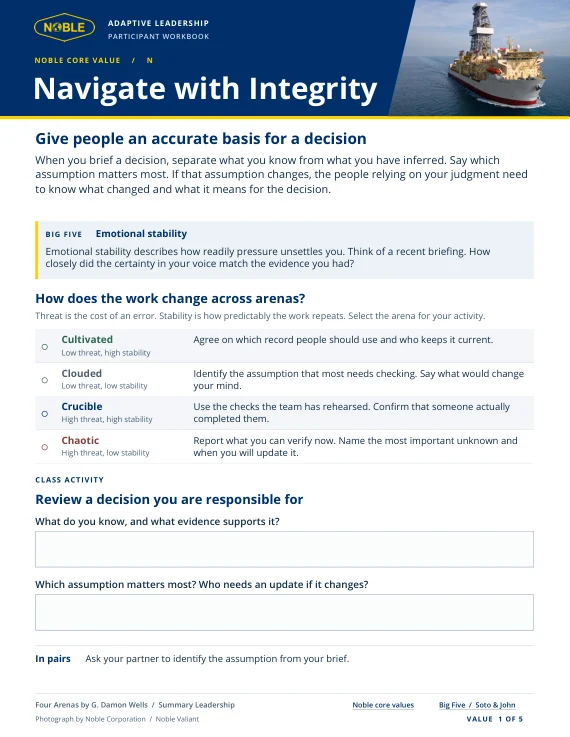
Participant workbook

Navigate with
Integrity

A calm briefing can make an estimate sound like a confirmed fact. This worksheet connects Noble’s value to a Big Five tendency and asks what a supervisor should say in each Arena.

Participants finish the page by naming one action a colleague could observe on the next shift.

Download the sample PDF Noble’s published core values
Preview of the Navigate with Integrity worksheet from the participant workbook

Employer view

What the sponsor sees

The day-90 report answers two questions. Could supervisors demonstrate the skill in front of a panel? Did managers observe it during routine work?

Pilot closeout

Fictional cohort · 12 supervisors
EvidenceSample resultWhat it measures
Field observation at entry4 / 12Supervisors demonstrated all four behaviors during a handover and coaching conversation.
Field observation at closeout8 / 11Eight met the same standard. One supervisor missed the closeout observation.
Individual board10 / 12Ten scored at least 3 of 4 in every leadership responsibility. Two need targeted reassessment.
What the sponsor would discuss

The proposed expansion threshold is nine supervisors meeting the field standard. Eight have demonstrated it. Schedule the missing observation before deciding whether to expand.

Individual 360 reports stay with the participant. Peer and crew ratings in those reports require at least five eligible observers per item.